
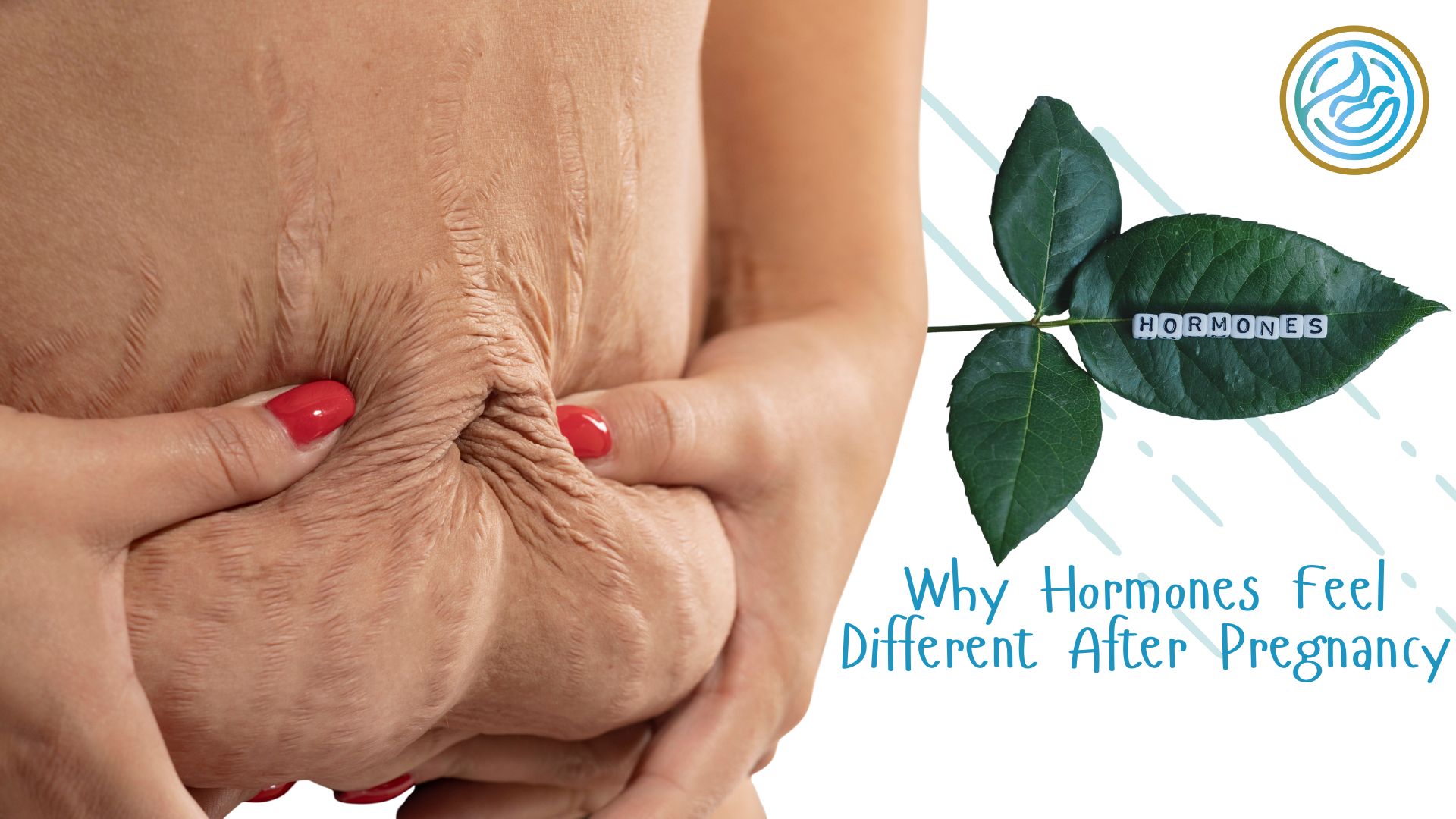
Many women expect their bodies to change after pregnancy weight, sleep, energy, routine. What often comes as a surprise is how different their hormones feel, sometimes for months or even years after giving birth.
Women frequently describe feeling “not like themselves,” emotionally flatter or more reactive, less resilient to stress, or hormonally unfamiliar even when cycles return and blood tests appear normal.
These changes are not imagined. Pregnancy and childbirth fundamentally reshape the hormonal system, and recovery is not simply a matter of time passing.
Pregnancy Is a Hormonal Event Like No Other
During pregnancy, hormone levels rise to ranges the body will never experience again outside of gestation. Estrogen and progesterone increase exponentially, while prolactin, oxytocin, cortisol, and thyroid hormones all adapt to support pregnancy and fetal development.
After birth, this system shifts abruptly.
Within days:
- Estrogen and progesterone drop dramatically
- Prolactin rises to support lactation
- Cortisol patterns change
- Sleep disruption alters circadian hormones
This sudden hormonal withdrawal is one of the most profound endocrine transitions the female body undergoes.
Postpartum Hormones Don’t “Reset” , They Reconfigure
A common misconception is that hormones return to a pre-pregnancy baseline after birth. In reality, the body reconfigures rather than resets.
Factors influencing this process include:
- Mode of delivery
- Blood loss during birth
- Breastfeeding
- Sleep deprivation
- Stress load
- Nutrient depletion
- Pre-pregnancy hormonal health
As a result, two women with similar pregnancies may have very different postpartum hormonal experiences.
Common Postpartum Hormonal Experiences Women Report
Many postpartum symptoms are normalised, but they are still hormonally driven and deserve understanding.
Symptom Checklist: Hormonal Shifts After Pregnancy
Symptom | Often Explained As | Hormonal Factors Involved |
Emotional sensitivity | “Baby blues” | Estrogen withdrawal |
Anxiety | New responsibilities | Cortisol dysregulation |
Low mood | Adjustment period | Progesterone depletion |
Brain fog | Sleep loss | Thyroid and cortisol shifts |
Low libido | Tiredness | Estrogen and androgen changes |
Hair shedding | Normal postpartum | Estrogen drop |
Cycle changes | Body recovering | Ovulatory disruption |
These symptoms may fluctuate, overlap, or persist longer than expected.
Breastfeeding and Hormonal Suppression
Breastfeeding significantly alters hormonal balance. Prolactin suppresses ovulation by inhibiting the hormonal signals required for progesterone production.
This means that:
- Estrogen may be present without adequate progesterone
- Cycles may be irregular or absent
- PMS-like symptoms can appear even without periods
- Mood and sleep may feel hormonally unstable
These effects are physiological, not pathological but they can still be challenging.
Normal Recovery vs When Hormones Feel “Off”
Postpartum recovery is not linear. However, there are differences between expected adaptation and ongoing imbalance.
Table: Expected Postpartum Hormonal Changes vs Ongoing Disruption
Experience | Expected Adjustment | When to Look Deeper |
Mood changes | Improving by months | Persisting or worsening |
Fatigue | Gradual improvement | Debilitating exhaustion |
Cycles | Variable return | Severe PMS or pain |
Anxiety | Situational | Constant or intrusive |
Libido | Slowly returning | Absent with distress |
Feeling different does not automatically mean something is wrong but feeling persistently unwell should not be dismissed.
Nutrient Depletion and Hormonal Recovery
Pregnancy, birth, and breastfeeding are nutritionally demanding. Key nutrients involved in hormonal recovery include:
- Iron
- Zinc
- Magnesium
- B vitamins
- Essential fatty acids
Even mild depletion can affect:
- Thyroid function
- Progesterone production
- Stress tolerance
- Energy regulation
Because depletion develops gradually, symptoms are often attributed solely to motherhood rather than physiology.
Why Blood Tests Often Don’t Explain the Experience
Postpartum hormonal changes are complex and dynamic. Standard tests may:
- Appear normal
- Miss tissue-level deficiencies
- Fail to reflect hormone ratios
- Overlook circadian disruption
Additionally, many women are tested only when symptoms become severe, rather than during early adjustment phases.
Hormonal distress does not always correlate neatly with lab abnormalities.
Emotional and Hormonal Changes Are Intertwined
Hormones influence how emotions are processed, not whether emotions are valid. After pregnancy:
- Estrogen affects serotonin and dopamine
- Progesterone influences GABA and calm
- Cortisol shapes stress reactivity
This means emotional changes often have a biological foundation, even when life circumstances are also demanding.
Why “Time” Is Not Always Enough
While time supports healing, it is not the only factor. Recovery depends on:
- Rest quality
- Nutritional replenishment
- Stress load
- Support systems
- Pre-existing hormonal balance
Without support, some women remain hormonally dysregulated long after the postpartum period is considered “over.”
Reframing Postpartum Hormonal Health
Feeling different after pregnancy does not mean you are broken, it means your body has adapted to an extraordinary physiological event.
Hormonal recovery is not about returning to who you were before, but about finding stability in a changed system.
Women deserve language that explains what they are feeling, rather than reassurance that dismisses it.
Key Takeaway
Postpartum hormones do not simply bounce back. They shift, adapt, and settle over time and when that process feels difficult, it deserves understanding, not minimisation.